
Gilmer County VINE Coverage
West Virginia calls the service Victim Information and Notification Everyday, or VINE. WVDCR says it began operating in the state in December 2002. Coverage extends across all ten regional jails and all state prisons and correctional facilities. That makes the service relevant to Central Regional Jail and Correctional Facility, which serves Gilmer County, and to people in the WVDCR state prison system.
VINE is not a county release list. It checks a named person and can accept a registration for later custody changes. It is also not the search for FCI Gilmer, despite the federal prison's location in the county. Federal Bureau of Prisons records use the BOP Inmate Locator. ICE custody uses a separate locator, while court records explain the legal order behind a bond, dismissal, sentence, or other case result.
| Custody system | VINE coverage | Primary confirmation source |
|---|---|---|
| CRJCF regional jail | Yes | WVDCR jail search, CRJCF record, and court order |
| WVDCR state prison | Yes | WVDCR prison search and sentence record |
| FCI Gilmer or other BOP facility | No | BOP Inmate Locator and federal record |
| ICE detention | Not the controlling system | ICE Online Detainee Locator and ICE assistance line |
Search Gilmer County VINE
Use the official West Virginia VINELink interface for a one-person check. Start with the exact name. An offender number greatly reduces false matches when it is known. Compare the supplying agency and facility because a common name may produce more than one record, and a Gilmer case does not mean the person is physically housed inside Gilmer County.
- Select West Virginia on VINELink.
- Choose the offender search and enter the exact first and last name, plus the offender identifier when available.
- Compare each result's agency, facility, and other identifiers before selecting a record.
- Open only the matching record and read the custody label exactly as displayed.
- Record the last-updated time and the time of the check.
- Corroborate a released or out-of-custody label through WVDCR, CRJCF, or the controlling court record.
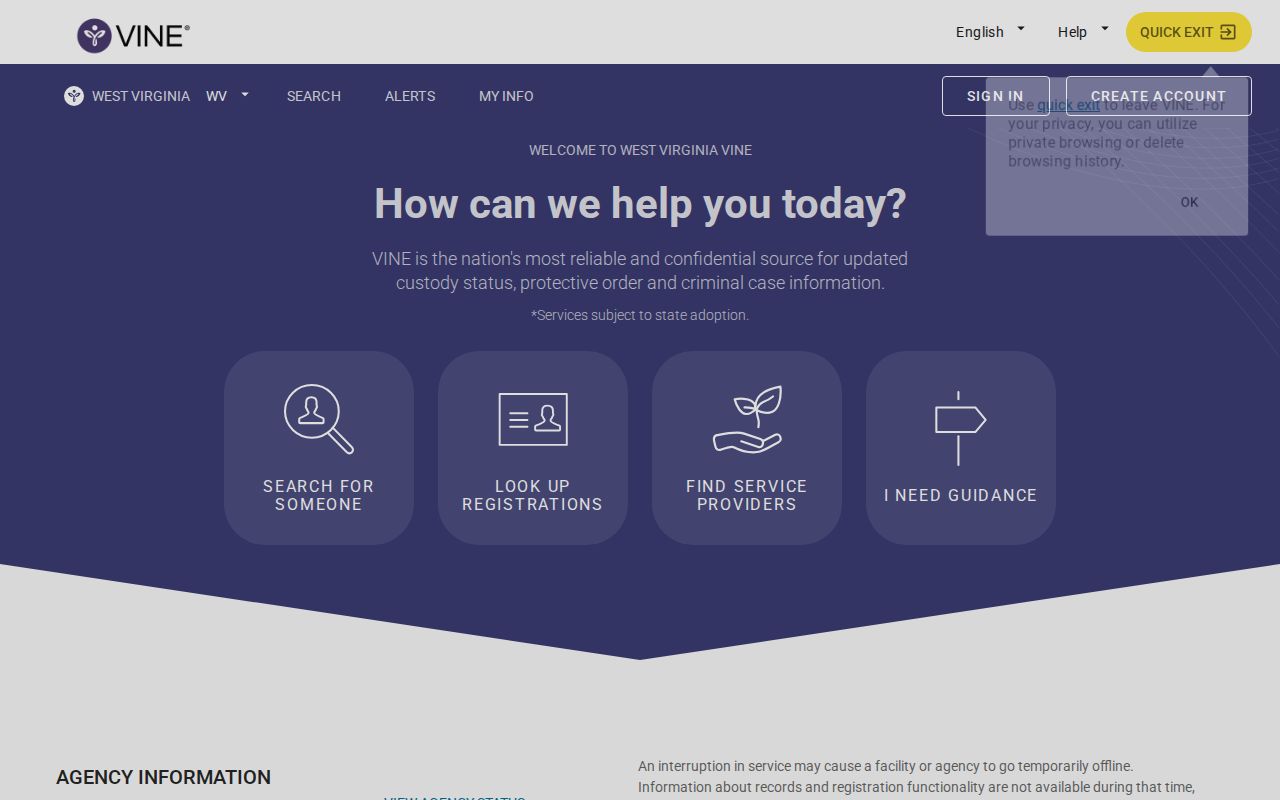
The official source image from the project manifest shows the West Virginia-specific person-search interface.
Note: Never publish a registrant's phone number, email address, app account, or private notification PIN in a screenshot.
Gilmer County VINE Results
A VINE record can identify the agency-reported status at a point in time. Read fields as labels, not assumptions. “Released” or “out of custody” is a strong lead that the supplying agency reported a custody change. It does not by itself explain whether the person went home, transferred to another authority, began parole, or remained subject to a court or supervision condition.
| Field | How to use it |
|---|---|
| Name and offender ID | Confirm the result belongs to the intended person |
| Supplying agency | Identify which correctional system reported the data |
| Facility or location | Show the reported custody site when available |
| Custody status | Preserve the exact current, released, or out-of-custody wording |
| Update time | Measure how fresh the record was when checked |
| Registration control | Begin enrollment for offered custody-change notices |
| Scheduled field, if shown | Treat a future date as conditional, not actual release |
A jail release record can add the event date and time, release category, authority, and receiving agency. The court order can explain bond, dismissal, time served, or another legal basis. Those records answer details that the VINE status label may not contain. For a state prisoner, WVDCR's prison result may also distinguish projected discharge from actual discharge.
Register Gilmer County Release Alerts
Registration begins from the matched person's record. The live interface may offer phone, text, email, or app notification. Current controls can change, so follow the labels shown on the screen rather than relying on an old screenshot. Enter the destination with care. A wrong digit or address can prevent the alert from reaching the intended recipient.
- Open the verified person's record and choose “Register” or the current equivalent.
- Select an offered delivery channel and enter the private phone number, email address, or app destination.
- Complete the confirmation process that the live service supplies.
- For automated phone calls, create the requested private four-digit PIN.
- When an alert call arrives, enter the PIN to acknowledge it and stop repeated calls.
- Keep the registration details private and update them if the contact route changes.
The official WVDCR VINE page also supplies 1-866-WV4-VINE, or 1-866-984-8463, for custody information and automatic phone registration. A registration can concern changes beyond final release, including movement or transfer. The message itself should be read for the event type.
VINE registration is distinct from written statutory notification. Under West Virginia Code §62-12-23(d), a qualifying written request must go to both WVDCR and the Parole Board because they are separate agencies. WVDCR says a written request to DCR also registers the victim with VINE. An ordinary online account should not be assumed to replace that written process.
Gilmer County Transfer Alerts
West Virginia's expanded VINE coverage creates an important Gilmer County safeguard, but transfers need careful reading. WVDCR says transfer notice is withheld until the person reaches the receiving facility for officer safety. A temporary gap, a changed site, or a delayed alert during movement is therefore not proof that the person entered the community.
This rule is especially relevant because a person held at CRJCF can move into the WVDCR prison population, another jurisdiction, federal custody, or another facility. Check the receiving system as well as the sending one. A state-sentenced person may stop appearing in the regional-jail index and later appear in the prison search without having been released.
When the destination is unclear, ask CRJCF or WVDCR for the existing release or transfer entry and the receiving agency field if it is releasable. A transfer ends one placement. It does not necessarily end custody. Record the exact terms used in both source systems.
Note: A delayed transfer notice protects movement details and must not be converted into an unsupported claim of community release.
Gilmer County VINE Limits
VINE depends on data supplied by participating agencies. It warns users not to rely on the service as the sole measure of safety or custody. A delayed update, misspelled name, identifier mismatch, sealed matter, transfer, or system issue can affect a search. “Not found” does not prove that custody ended.
The service also does not determine whether parole or probation has ended. A person can be physically released and remain under supervision. A VINE result does not show every court condition, federal hold, ICE matter, or another jurisdiction's record. Check the source that controls the specific question.
- Custody status
- The supplying agency's report of whether and where it holds the person.
- Transfer
- Movement from one facility or authority to another, not necessarily community release.
- Detainer
- A request or legal basis for another authority to assume or maintain custody.
- Discharge
- A formal end to a custody or supervision obligation, supported by an agency or court record.
For FCI Gilmer, search the BOP Inmate Locator. A past federal release date shows departure from BOP custody as described by BOP, but another justice system or supervision may still apply. For ICE, use its locator and assistance channel. Neither source is folded into a West Virginia VINE result.
Confirm Gilmer County Release
After an alert, note the message time, event type, supplying agency, and record update time. Next, check the WVDCR jail or prison index that matches the person's custody. If the result says released or disappears, contact CRJCF or the relevant WVDCR office and request the existing release entry when exact proof is needed.
Then inspect the case record. Gilmer County magistrate records can contain the first appearance, bond, and lower-court disposition. Circuit records hold felony orders, sentencing, probation, and later events. An order's filing date may differ from the physical exit time, so compare it with the facility record rather than choosing one source over the other.
The Gilmer County released-inmate search maps those county, state, court, and federal channels. VINE performs its best role when used for notice, followed by source-level confirmation. That sequence preserves the value of a fast alert without asking the notification system to prove facts it does not hold.
Gilmer County Registry Difference
The West Virginia State Police Sex Offender Registry is not a VINE substitute. It applies only to people with a legal duty to register. A listed person may have a photo and registered location, but continued display reflects registration law rather than present jail custody. An absent name proves nothing about release.
Use the registry only when that specific legal status is relevant. Its official warning says information may change or go unreported and must not be used for threats or harassment. Corrections can be directed to the State Police registry contact. For ordinary CRJCF or WVDCR custody changes, stay with VINE and the corrections record.
Keeping these systems separate prevents three common errors: treating a registry as a released-inmate list, treating a VINE alert as a signed order, and treating an old jail roster entry as proof of present custody. Each source has a narrow job.