
Gilmer County Release Date Types
A projected date is a current computation, not an appointment. It can move when credits, discipline, sentencing orders, detainers, or parole decisions change. The actual release date is historical evidence that the person left a particular custody system. A parole eligibility date, often called PED, is only the point when an eligible person may be considered for parole. West Virginia law says eligibility does not create a right to release.
Custody type comes first. A Gilmer case commonly places a detainee at Central Regional Jail and Correctional Facility, which WVDCR operates in Braxton County. A state-sentenced prisoner may later appear in the WVDCR prison search. FCI Gilmer is a federal prison and uses the Bureau of Prisons locator. The similar local names do not merge their records.
| Date or status | What it means | Best source |
|---|---|---|
| Parole eligibility date | Review may begin; release is not promised | WVDCR record and Parole Board material |
| Projected or minimum discharge | Current sentence computation if facts stay unchanged | WVDCR prison result and computation statement |
| Actual release or discharge | Recorded departure from that custody system | WVDCR or facility release entry |
| Court disposition date | Date an order or docket event was entered | Signed court order; not necessarily exit time |
Lookup Gilmer County Release Dates
Begin with a full name and a stable identifier such as a WVDCR offender number, booking number, or court case number. Search spelling matters. Preserve the exact source label, current facility, status, and time checked. A blank field or missing name cannot safely be translated into release.
- Identify county jail, state prison, or federal custody from the committing case and the latest reliable record.
- For a state prisoner, use the WVDCR offender-search hub and choose the prison search. Copy the precise future-date label shown on the result.
- For a CRJCF detainee, inspect the jail search, then read the bond, sentencing, credit, dismissal, or other release-related court order.
- Call CRJCF at 304-765-7904 when the live result does not settle the current status or exact release entry.
- For an authoritative state sentence calculation, contact WVDCR Records with the offender number and request the sentence-computation statement.
- For a federal prisoner at FCI Gilmer, use the BOP locator and interpret its projected or past date under BOP rules.
Pretrial custody follows the court, not a sentence calculator. A person can leave after bond, recognizance, dismissal, or another order, and an unresolved hold may prevent community release. The Judiciary access page routes users to magistrate and circuit records. Search both when the case moved from an initial felony proceeding to circuit court.
Note: Record the date and time of each live search because dynamic custody and projected-date fields may change after the check.
Gilmer County Good-Time Calculation
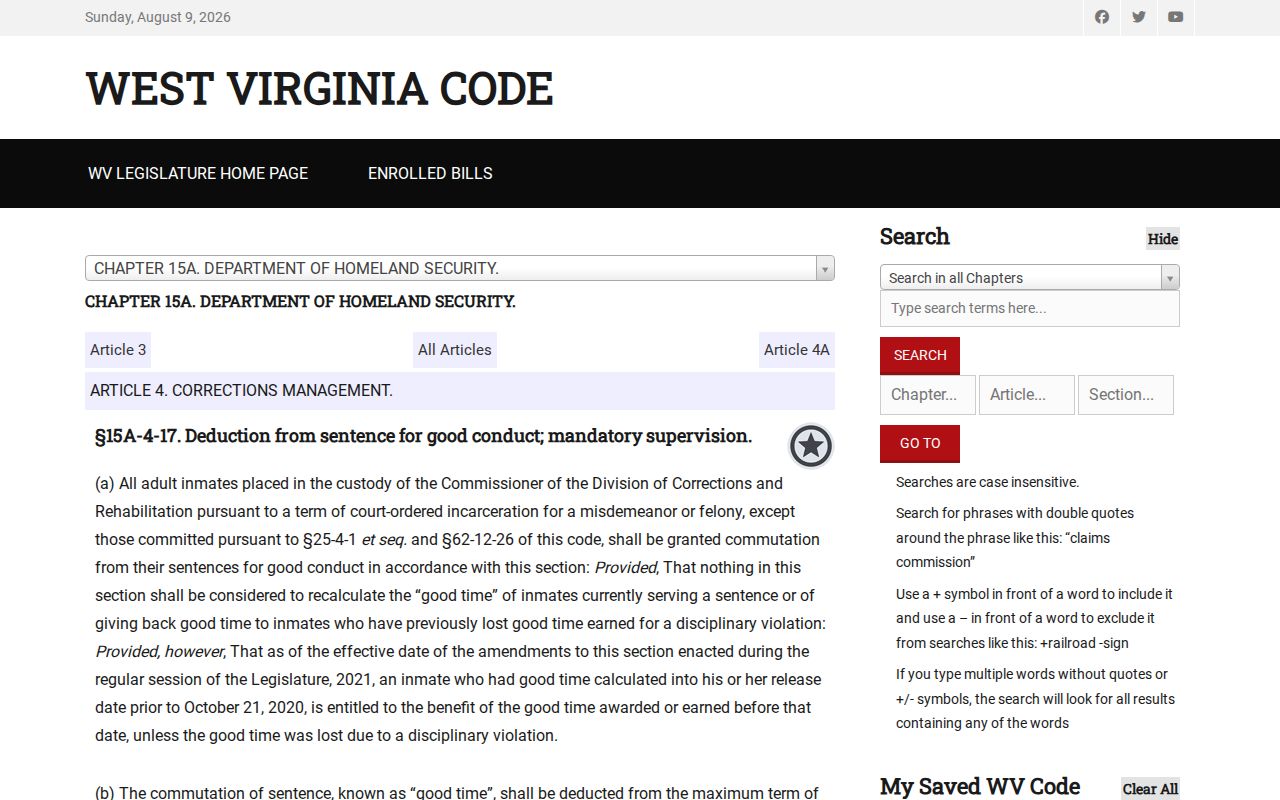
West Virginia does not impose a blanket rule that every eligible state inmate must serve about 85 percent of a sentence. That federal shorthand does not belong in a Gilmer County WVDCR calculation. The state framework begins with West Virginia Code §15A-4-17, along with the sentence, statutory exceptions, court-awarded jail credit, and parole law.
Under §15A-4-17(c), an eligible adult inmate committed to the commissioner and physically incarcerated receives one day of good time for each day incarcerated. Eligible presentence jail days credited under §61-11-24 are included. The credit is deducted from the maximum term of an indeterminate sentence or the fixed term of a determinate sentence. Time spent on parole, bond, or another status outside physical incarceration does not earn this good time. Life sentences do not earn it under this section, and statutory exclusions must be checked.
Eligible felony inmates may also receive added credit for approved, nonrequired academic or vocational programs, up to the limit set in the statute. Qualifying meritorious service or emergency duty can support discretionary extra credit. Consecutive sentences are aggregated as one term for eligible good-time computation. These are record-based rules, not numbers to estimate from a docket summary.
The official West Virginia good-time statute shows the governing discharge framework.
Why Gilmer Release Dates Move
The Gilmer County date is mutable because the underlying computation can change. Good time can be forfeited for disciplinary violations and may later be restored under statute and policy. WVDCR must revise the inmate's statement when forfeiture, revocation, or restoration changes the earliest discharge. A corrected presentence credit or amended sentence can also shift the result.
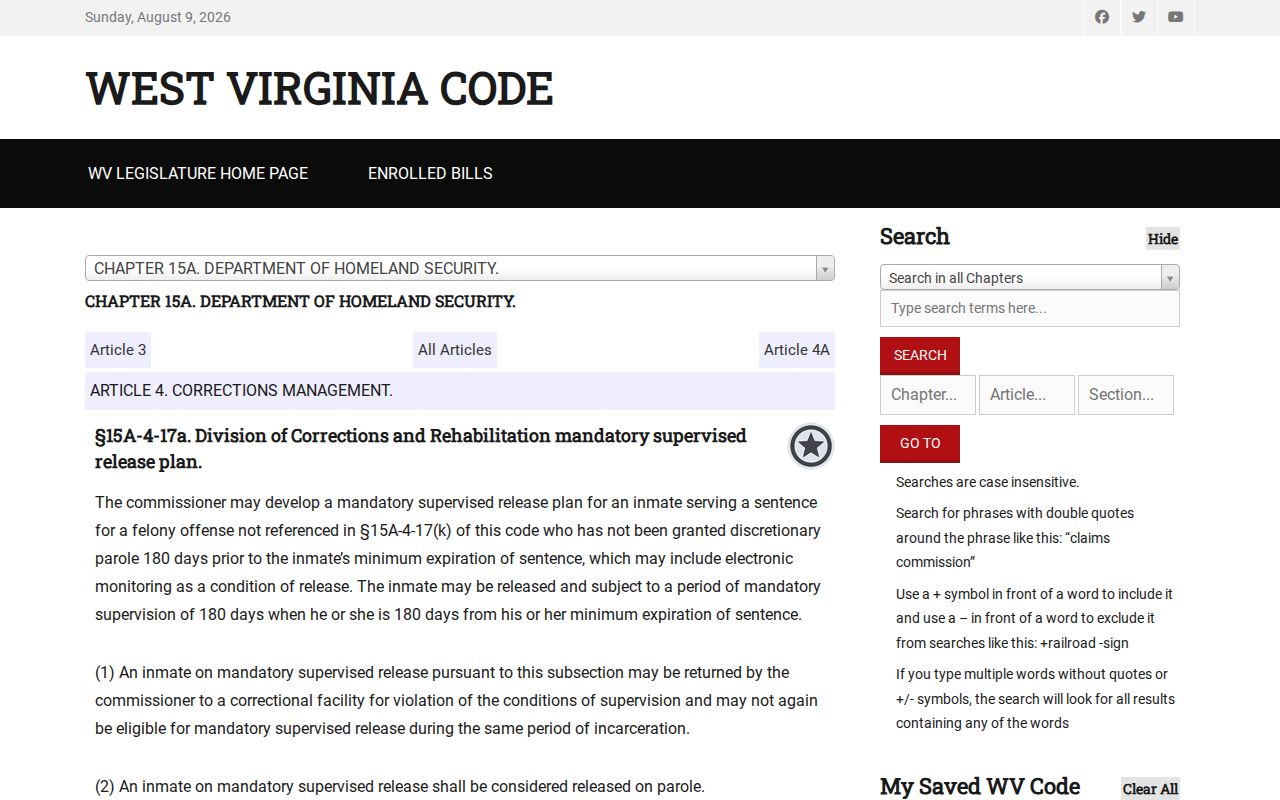
A second statute creates a different form of conditional release. Under §15A-4-17a, WVDCR may develop a mandatory-supervision plan for a qualifying felony inmate who falls outside the listed exclusions and has not received discretionary parole. Release may occur 180 days before minimum sentence expiration. The person is treated as released on parole and remains supervised until minimum expiration.
That provision does not mean every prisoner leaves 180 days early. Eligibility, an approved plan, detainers, and exclusions all matter. It also does not turn conditional release into full sentence discharge. The conditional-release statute supplies the official wording shown below.
Gilmer County Date Changes
A future result is only as current as the facts WVDCR has applied. Some events change the mathematical computation. Others change whether the person actually exits to the community on that day. The distinction prevents a projected date from being overstated.
| Factor | Effect on the date or release |
|---|---|
| Good-time forfeiture or restoration | Moves the earliest computed discharge as WVDCR revises the credit statement |
| Presentence jail credit | A court award or correction changes time credited toward the sentence |
| Amended or consecutive sentence | Changes the controlling term or aggregated calculation |
| Detainer or receiving authority | May prevent release to the community even when one custody term ends |
| Parole decision | May permit earlier conditional release, but eligibility or a grant is not the exit itself |
| Escape time or statutory exclusion | Can alter credit treatment under the applicable law |
A detainer is a request or legal basis for another authority to take or maintain custody. It changes the destination, not necessarily the fact that WVDCR ended its own custody segment. Ask the release record to name the receiving agency when that field is releasable. A transfer to state prison is also not a release to the community.
Gilmer County Parole Timing
Baseline parole eligibility under §62-12-13 can begin after the minimum term of an indeterminate sentence or one fourth of a definite term, subject to exclusions and enhancements. Firearm cases, life sentences, offense dates, and other rules can change that baseline. New provisions for some offenses committed on or after July 1, 2026 require the current statute to be checked against the individual case.
The Board may grant, deny, or defer while it examines a proposed plan. Even a grant from a regional jail does not mean same-day release. The Board advises that a person granted parole from a regional jail may first be moved to a DCR facility for intake and fingerprinting, with an anticipated delay of seven to ten days before physical release.
Confirm the WVDCR release entry after the Board decision. The decision establishes authority and conditions. The facility record establishes when the physical custody event occurred. Those two dates can be different without either record being wrong.
Gilmer Release System Boundaries
A county or regional detainee may have no projected prison discharge date. The immediate answer may depend on a bond order, sentence credit, or CRJCF calculation. Request the exact release-log entry if the jail search changes. For a state-sentenced prisoner, the WVDCR prison index and Records office are the right route.
FCI Gilmer requires a federal lookup even though it sits in Glenville. The BOP result can display a future projected date or a past release date. “Released” or “Not in BOP Custody” means BOP no longer holds the person; it does not rule out another jurisdiction or post-custody supervision. “In Transit” also should not be called release.
A missing record has several possible causes: spelling, source mismatch, transfer, a sealed matter, data lag, or removal from a live index. The complete Gilmer County released-inmate search describes the county, state, federal, and court paths for confirming which system holds the answer.
Do not mix dates across sovereigns. A WVDCR release date closes or changes state custody, while a BOP release date speaks only to federal custody. If another agency receives the person, the first system may correctly say released even though confinement continues elsewhere. The receiving-agency field, detainer record, and next locator result explain that handoff.
Confirm Gilmer County Release
Use VINE to receive a custody-change alert for CRJCF or a WVDCR state facility, but treat it as a notification layer. The agency supplies its data, and a lag can occur. A transfer alert can also be held until arrival at the receiving institution. VINE does not cover FCI Gilmer or compute the sentence.
When exact timing matters, request the existing release or discharge entry. For WVDCR sentence records, ask for the public face sheet, sentence computation, actual discharge date, release category, and release certificate as appropriate. A focused request is easier to route and avoids seeking a broad institutional file.
Compare three items before treating the date as final: the order or sentence that supplies legal authority, the system-specific projected date, and the later facility entry showing actual release or transfer. That sequence answers both “when was release expected?” and “when did it happen?” without confusing eligibility, projection, and history.
Note: Court filing dates and parole decisions can explain authority, but the facility record supplies the physical exit or transfer time.