
Gilmer Court Release Records
Gilmer County Magistrate Court handles misdemeanors, bail, warrants, and preliminary felony proceedings. Gilmer County Circuit Court is the felony trial court and court of record. A single custody event can touch both. The first appearance and bond may be in magistrate court, while indictment, plea, conviction, sentence, probation, revocation, dismissal, or an amended order appears in circuit court.
The docket creates a durable legal history after an operational jail result changes. Useful release-related records include the criminal complaint, bail or bond order, dismissal, acquittal, sentencing order, jail-credit order, probation order, revocation order, and amended sentence. A court may state “time served” or grant enough credit to permit release. That proves legal authority, not necessarily the hour the facility completed its checks and opened the release door.
| Court document | Release question it can answer |
|---|---|
| Bond order | Whether release was authorized on stated bail or recognizance terms |
| Dismissal or acquittal | Whether the case no longer supported custody on that charge |
| Sentencing order | The term, probation, commitment, and other sentence terms |
| Jail-credit order | Whether credited time affects immediate or projected release |
| Probation order | Whether the court imposed community supervision |
| Revocation order | Whether probation or another status returned the person to custody |
Search Gilmer Release Orders
Use the West Virginia Judiciary court-record access page to reach both systems. Search Magistrate Record Search for the lower-court case and WVPASS for circuit matters. For a felony, search both because the case can begin in one and continue in the other. Use a case number when known and compare name, birth date, filing date, and charge details.
- Search the Magistrate Record Search by case number or name and select Gilmer County where the interface permits.
- Record the case number, filing date, charge, disposition, and listed documents for the matching case.
- Search WVPASS for the circuit case, sentence, and later orders.
- Request the signed bond, dismissal, sentence, credit, probation, or revocation order from the proper clerk.
- Confirm the physical exit with CRJCF or WVDCR when the exact release date and time matter.
The magistrate search returns up to 30 results and does not provide document images online. Its disclaimer warns that results may not be a complete case history and directs users to validate with the filing court. WVPASS may provide public circuit documents to registered users for a nominal fee. Sealed, expunged, juvenile, and other confidential records will not appear like ordinary public cases.
Gilmer Magistrate Court Records
Magistrate Court is the first court source for a misdemeanor case and many early felony events. The free search accepts a first name, last name, or case number. Typical results include name, birth date, filed date, charge, disposition, and a document list. Those fields can identify the case and show that a bond or disposition event exists, but the underlying order is needed for exact terms.
The official magistrate search instructions explain the system and its limits.
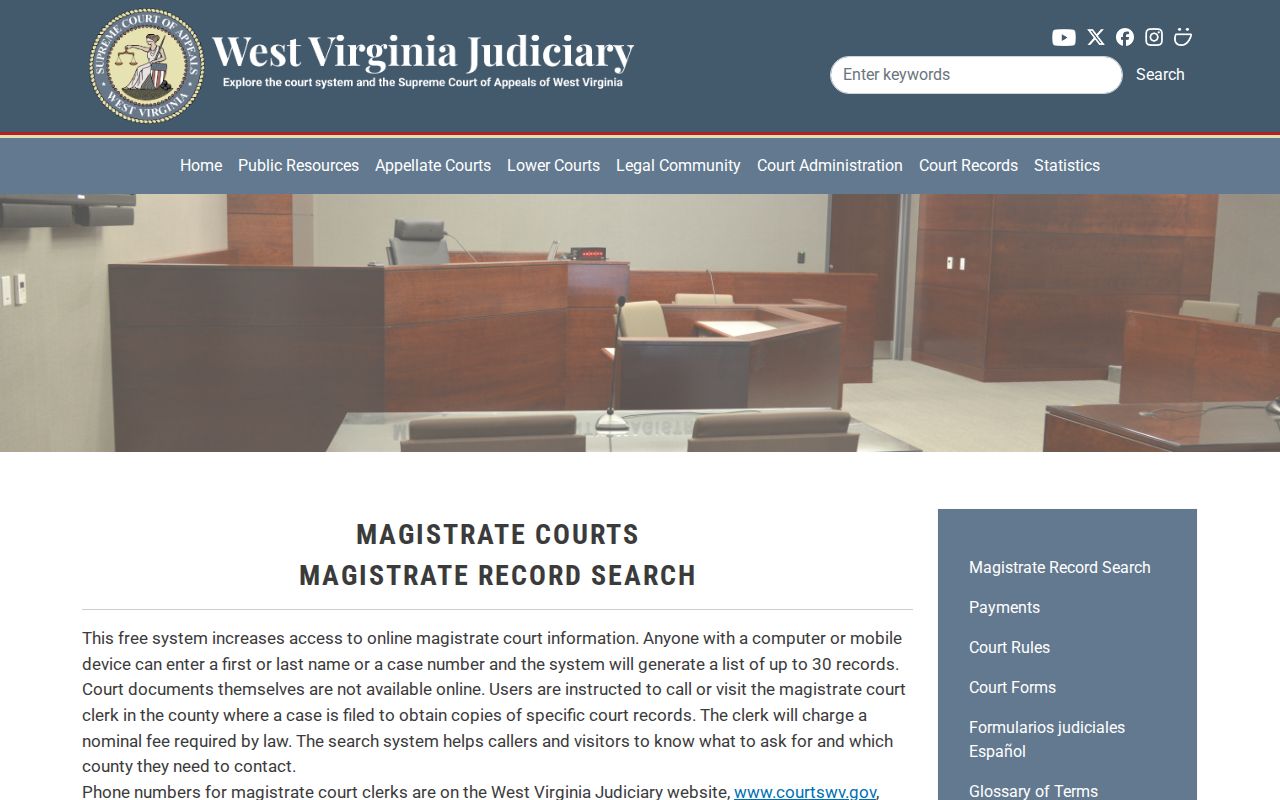
The instructions reinforce that document images are not available through the search. Contact the Gilmer Magistrate Clerk for the signed order or other public copy. Ask for a document by case number and title instead of requesting a broad case narrative.
Bridget Norman
Gilmer County Courthouse
201 North Court Street
Glenville, WV 26351
304-462-7812
Fax: 304-462-8582
Gilmer Circuit Court Orders
Circuit Court is the key source for a felony sentence, probation order, later revocation, dismissal, acquittal, jail-credit order, and amended judgment. Use WVPASS to locate the docket and available public documents. Then request the specific signed order from the Gilmer Circuit Clerk if the system does not provide it or if the record’s meaning is unclear.
The official Gilmer Judiciary page provides the local court and clerk contacts.
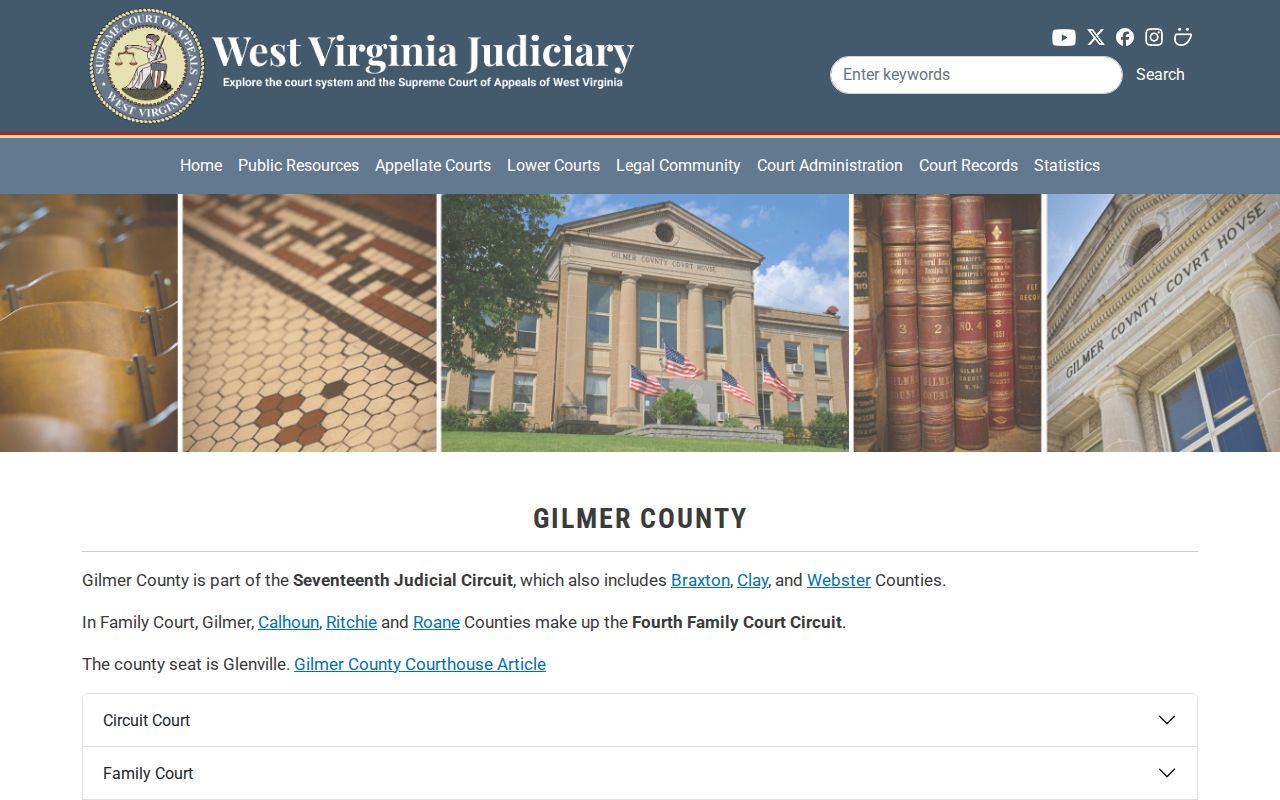
The official contact record helps route copies to the correct clerk. The county also provides a Circuit Clerk page with local hours and the clerk’s record-keeper role.
Pam Starsick
10 Howard Street
Glenville, WV 26351
304-462-7241
Fax: 304-462-7038
pam.starsick@gilmercountywv.gov
Monday through Friday, 8 a.m. to noon and 1 to 4 p.m.
Gilmer Clerk Release Copies
The Gilmer County Circuit Clerk page is a separate local source for the office’s record role and contact route.
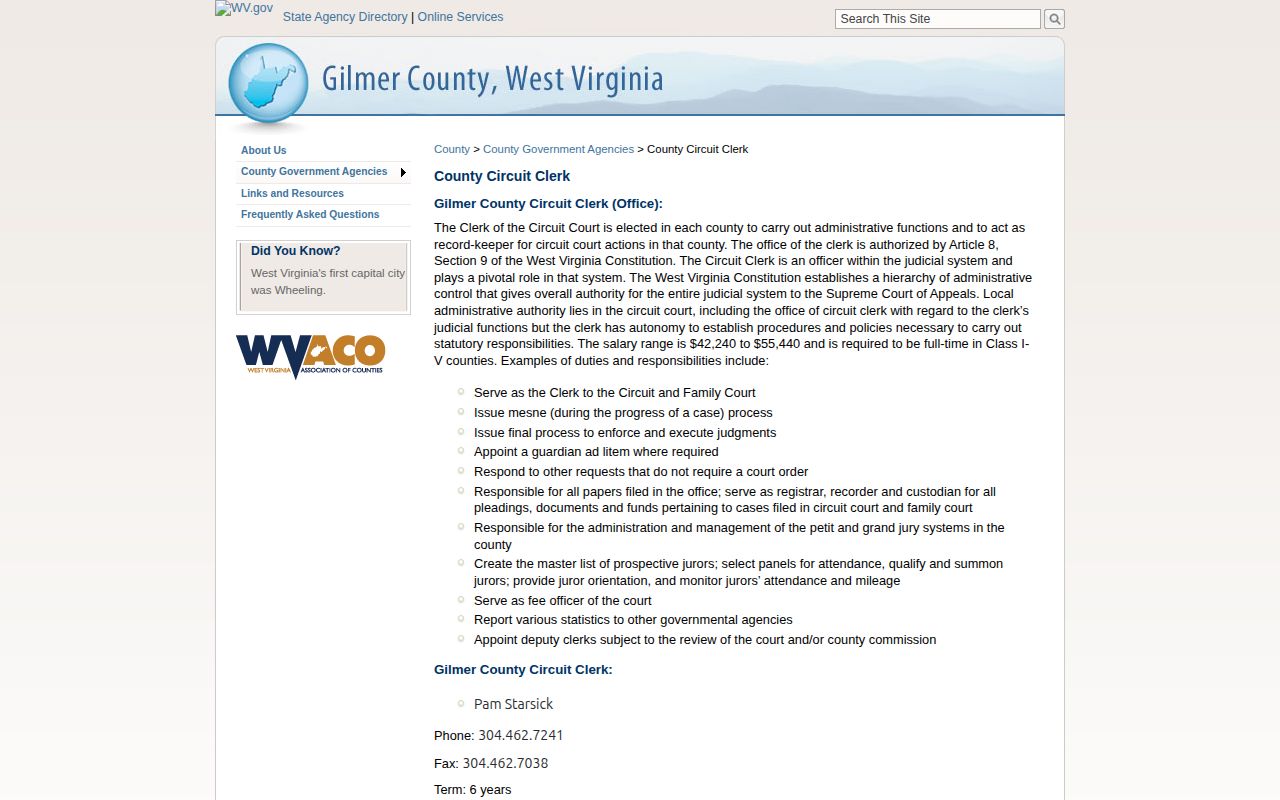
This local page supports requests for felony docket and sentencing or release-related orders. Give the case number, party name, document title, and approximate filing date. Public circuit downloads and clerk copies may carry nominal fees, so ask for the current amount before a large request.
For a physical release record, the court clerk is not the only custodian. If the person was at CRJCF, request the facility release log from CRJCF/WVDCR. If the person was serving a state-prison sentence, request WVDCR’s sentence computation and actual discharge record. A court clerk should not be asked to certify what time a correctional agency completed release unless the court’s own record contains that fact.
Match Gilmer Court and Jail
Most people detained on a Gilmer matter are routed through Central Regional Jail and Correctional Facility in Sutton. WVDCR runs CRJCF and the public jail search. The Gilmer County Sheriff arrests and transports people but does not publish a county jail roster. Match the court case to the WVDCR record through name, birth date, case number, booking or offender identifier, arrest date, and committing court.
A consistent proof set has three parts. The court order provides legal authority. The facility release entry provides the physical date, time, type, and receiving authority when those fields are releasable. A later prison, BOP, ICE, or supervision record shows the next status if custody did not end. If the sources conflict, preserve each exact label and ask the custodians to clarify their own fields.
- Disposition
- The court’s recorded outcome or procedural result.
- Remand
- An order returning or committing a person to custody.
- Time served
- A sentence or credit finding tied to time already spent confined.
- Release log
- The facility record of physical departure and release type.
- Detainer
- Another authority’s request or custody interest that may prevent community release.
Note: Two people with the same name can have different cases, so match identifiers before linking any court order to custody.
Gilmer Court Release Limits
A signed bond order may still require payment, verification, or other conditions before release. A dismissal in one case may coexist with a hold in another. A sentencing order may commit the person to WVDCR rather than send the person home. A probation order can release a person from confinement while creating court supervision. Read the whole operative order and check all known case numbers.
Transfer is another common limit. A person leaving CRJCF for a state prison, another county, BOP, USMS, a hospital, or ICE did not necessarily return to the community. If a facility record states only “released,” ask whether the destination or receiving-agency field is available. A court result does not always reveal that operational handoff.
Parole is decided by the West Virginia Parole Board, not Gilmer County Courts, although the original judgment and sentence affect eligibility. Federal supervised release comes from a federal judgment and is not state parole. The court system must match the sovereign that imposed the sentence.
Gilmer Court Expungement Effects
Expungement can change public visibility. West Virginia Code §61-11-25 addresses qualifying acquittals and dismissals, while §61-11-26 addresses eligible convictions, waiting periods, exclusions, and procedure. An expungement order can seal court material and direct action by law-enforcement repositories.
A missing court result may therefore reflect a lawful seal rather than a search error or proof that an arrest never happened. Juvenile and other confidential proceedings have separate rules. Do not ask a clerk to reveal sealed content. When a person has an expungement order, the order itself and the applicable agency process govern requests for action on related public records.
West Virginia FOIA does not override sealed or exempt material. Section 29B-1-4 includes personal and law-enforcement-related exemptions, and public bodies may redact segregable protected content. A narrow request for a releasable order or release field is more defensible than a demand for an entire correctional file.
CRJCF History Shapes Court Search
CRJCF opened on February 22, 1993 as the prototype for West Virginia’s regional-jail design. It serves eight counties, including Gilmer, from neighboring Braxton County. That history explains why a Gilmer court can commit a person to a state-run facility outside the county and why the local sheriff does not host the jail roster.
The regional structure creates a clear records division. Gilmer courts keep legal orders. The sheriff keeps its own arrest and transport records. WVDCR keeps the CRJCF custody and release entry. A state sentence may later move the person to a prison elsewhere in West Virginia. FCI Gilmer is separate federal custody despite its local name.
Use the court location to find the case, not to assume the detention site. Conversely, use the facility operator to find the custody record, not to infer which court imposed the order. Linking those two systems is the core of an accurate Gilmer release inquiry.
After a Gilmer Court Release
A court-authorized release may include probation, bond terms, future hearings, or another legal duty. The Gilmer County Probation Office is at 10 Howard Street in Glenville, telephone 304-462-7521. Contact it only after the signed order confirms probation, and understand that protected supervision detail may not be disclosed.
If the person entered state prison, the WVDCR prison index and discharge record replace the regional-jail search as the main custody source. If the person was at FCI Gilmer, use BOP Locator and the federal docket. VINELink can notify users of WVDCR custody changes but is not the signed court order.
The Gilmer County released-inmate search and records page combines these routes for a named-person inquiry. Start with the court that controlled the case, then confirm the physical custody event through the office that held the person.