
Gilmer Sheriff Release Role
The Gilmer County Sheriff arrests people, executes court orders, transports prisoners, serves legal process, and performs peacekeeping duties. The official county page does not identify a sheriff-operated county jail or publish a custody roster or recent-release feed. A short-term holding space may be possible under state law, but no overnight county detention facility was confirmed. It would be inaccurate to call the Glenville office “Gilmer County Jail.”
When a deputy arrests someone on a county matter, the sheriff record can identify the arresting officer or agency, date, alleged offense, transport, and receiving facility where those fields exist and are releasable. Central Regional Jail and Correctional Facility normally supplies the regional-jail custody record. The committing court supplies the order for bond, dismissal, time served, probation, or another change. The sheriff is a valuable first routing point, but it is not a substitute for the WVDCR jail search.
| Question | Correct source |
|---|---|
| Where was the arrestee taken? | Gilmer Sheriff arrest or transport record |
| Is the person listed at CRJCF? | WVDCR jail search |
| What authorized release? | Gilmer Magistrate or Circuit Court order |
| When did the person leave CRJCF? | CRJCF/WVDCR release entry |
| Was the person transferred? | Sending and receiving agency records |
Find Gilmer Sheriff Detainees
Begin with a name, date of birth if known, arrest date, and case number. Ask the Sheriff’s Office which facility received the person. Then use the WVDCR offender-search hub and select the jail search for CRJCF custody. Record the exact search time and any booking identifier. A current result reflects listed custody at the source’s update time.
- Confirm the arresting or transporting agency through the sheriff record.
- Identify the receiving facility instead of assuming the person stayed in Glenville.
- Search the WVDCR jail index for CRJCF and note all identifiers.
- If the name disappears, check the state prison index and the court docket before claiming release.
- Request the CRJCF release entry for the physical date, time, type, and receiving agency when needed.
The live jail roster is operational, not a complete history. A missing name may reflect bond or another community release, but it can also reflect transfer, a spelling mismatch, delayed data, sealed or juvenile status, or removal from public display. Daily Incarcerations and admissions summaries are not release lists. Gilmer County has no confirmed official rolling 24-hour or 72-hour sheriff release feed.
Gilmer Sheriff Record Request
Send a request to the office that created the record. The sheriff is the right custodian for sheriff arrest, incident, court-service, or prisoner-transport material. CRJCF/WVDCR is the right custodian for regional-jail booking, custody, release-log, and booking-photo records. A Gilmer court clerk holds the signed order. Asking each office only for its own record produces a clearer and faster trail.
A focused request should state the full name, date of birth or other identifier, approximate arrest date, Gilmer case number, and desired format. Ask for the existing arrest and transport entries, the agency or facility that received the person, date and time of transfer if recorded, and field definitions for codes. Do not ask the sheriff to create a 24-hour release report that does not exist.
10 Howard Street
Glenville, WV 26351
304-462-7441
Fax: 304-462-5134
donald.belin@gilmercountywv.gov
The county identifies Donald E. “Smokey” Belin as sheriff. Under West Virginia Code §29B-1-3, a public-record custodian must make the initial response as soon as practicable and within five days excluding weekends and legal holidays. The response can produce records, set terms, explain delay, or deny with reasons. No sheriff fee schedule for these release-related records was confirmed, so request an estimate.
Gilmer Sheriff Photo Source
The official Gilmer County Sheriff page is the best source for the office’s current identity and contact route. The captured official page below helps distinguish the West Virginia agency from similarly named results in other states.
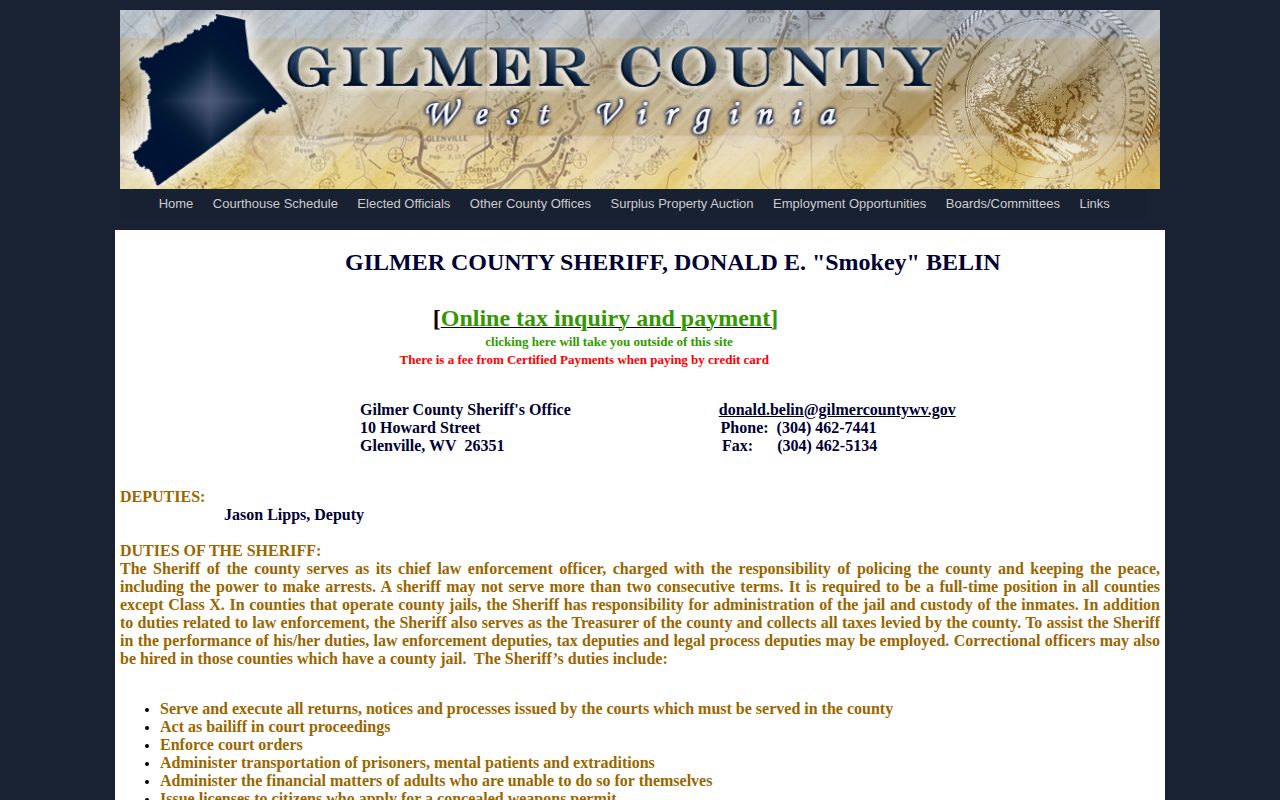
The page confirms law-enforcement, transport, court-order, and related duties. It does not display a local jail roster, recent-release view, or official mobile app. That absence determines the next step: use the sheriff to locate the receiving agency, then use the receiving agency’s custody and release system.
No official Gilmer County, West Virginia sheriff app was found. Search results for a “Gilmer County Sheriff” app and gilmersheriff.com concern Georgia. They must not be used for a West Virginia arrest, release, or mugshot. Check the `.wv.gov` domain, state, and office address before relying on a result.
Gilmer Court Release Authority
A sheriff arrest record does not establish the final case result. Gilmer Magistrate Court handles misdemeanors, bail, and preliminary felony proceedings. Circuit Court handles felony adjudication and sentencing. A two-system search may be needed because the initial appearance and bond can appear in magistrate records while a later plea, sentence, dismissal, probation order, or amendment appears in circuit records.
The free Magistrate Record Search accepts a name or case number and can show filing date, charge, disposition, and a document list. It does not provide document images. WVPASS covers circuit records. Obtain the signed order from the proper clerk when wording matters. A docket entry or order date still may not equal the time CRJCF completed physical release processing.
Match the sheriff record to the court case by name, birth date, case number, and arrest date. Then match the court order to the facility release entry. This three-record chain is stronger than relying on a name’s absence from a live search.
Note: A court order supplies legal authority, while the facility release log supplies the physical exit date and time.
Gilmer Sheriff Transfer Records
The receiving agency changes the lookup. CRJCF custody belongs in the WVDCR jail search. A person committed to a West Virginia prison belongs in the separate prison index. FCI Gilmer is a federal institution and belongs in BOP Locator, but local geography alone does not mean a sheriff arrestee went there. ICE ODLS is relevant only where immigration custody is a genuine possibility.
A transport record can close the gap between these systems. Ask whether the recorded destination was CRJCF, another county, a state correctional institution, a federal authority, a medical facility, or court. A transfer is not community release. Even the word “released” may mean released to another agency when the destination field shows a custody handoff.
- Arrest record
- The sheriff-created record of the enforcement event.
- Commitment
- Legal authority placing a person in a custodian’s charge.
- Transfer
- Movement between facilities or authorities.
- Release entry
- The keeping agency’s record of departure, type, and destination when available.
Gilmer Sheriff and CRJCF
Central Regional Jail opened on February 22, 1993 as the prototype for West Virginia’s regional-jail system. The Sutton facility serves eight counties, including Gilmer. Its state operation outside Gilmer County explains why the Sheriff’s Office transports prisoners but does not offer a sheriff-branded jail search.
The regional model divides responsibility. Sheriff records tell who arrested or moved a person. WVDCR records tell who entered or left CRJCF. Courts tell which legal order changed custody. This history also explains why a person can be arrested in Glenville, housed in Braxton County, sentenced by a Gilmer court, and later shown in a prison elsewhere in West Virginia.
That division should shape every request. Do not ask the sheriff for a CRJCF booking photo as though it were a county-jail record. Do not ask WVDCR for a sheriff incident narrative. Route each request to the creator and use identifiers to connect the responses.
After Gilmer Sheriff Custody
A person released to the community may still be subject to probation, parole, mandatory supervision, bond terms, or a future court date. Probation is imposed by a court. Parole follows state incarceration and is decided by the West Virginia Parole Board, with supervision through WVDCR. Neither status is shown merely because the person no longer appears in a jail search.
The local Gilmer County Probation Office is at 10 Howard Street in Glenville and can help route an appropriate probation question after the signed order confirms that status. A parole inquiry starts with the WVDCR offender record and release decision, then the responsible regional parole office. Protected case-management details may not be public.
If pickup planning is involved, contact CRJCF rather than the sheriff for the current exit point and release stage. No official CRJCF release time, public door, weekend procedure, or transit pickup was found. The Gilmer County released-inmate overview explains the full facility, court, supervision, and federal paths.