
Gilmer County 72-Hour Releases
There is no official Gilmer County or Central Regional Jail and Correctional Facility page that lists releases over a rolling three-day span. The county sheriff transports people and executes court orders, but WVDCR operates the regional jail serving Gilmer. The WVDCR offender-search hub offers a live jail search, a separate prison search, Daily Incarcerations, and escapee or absconder information. Daily Incarcerations is not a release archive.
A three-day reconstruction begins and ends at exact timestamps. If a person appeared on Monday but not Wednesday, that change narrows the question. It does not show whether the person left on bond, completed time served, entered probation, transferred to a state prison, or went to another custodian. An affirmative CRJCF release date and time resolves the physical event. A signed court order supplies the legal reason.
Check Gilmer County Three-Day Releases
Define the range before searching. Write the date, time, and time zone for both ends. Then check the WVDCR Regional Jail offender route and preserve the exact observation time, spelling, facility, and identifier. A result tied to CRJCF supports custody as shown by that system. A later no-result calls for another source.
- Search the WVDCR jail index at the end of the three-day window and record the result with its time.
- Check the separate WVDCR prison search for a state-sentenced transfer rather than assuming community release.
- Search Gilmer Magistrate Court and Circuit Court records for a bond, dismissal, probation, sentence-credit, or other custody-changing order.
- Call CRJCF at 304-765-7904 with the booking or offender identifier when prompt confirmation is needed.
- Request existing release-log entries between the exact start and end timestamps when no public result states a release.
VINE may supply a status-change notice, but it remains a notification system rather than the signed order or release log. The court event can also precede physical processing. For a same-day question, use the narrower Gilmer County 24-hour releases method and keep the end time fixed.
Gilmer Three-Day Release Fields
No public list displays a standard field set for Gilmer County 72-hour releases. The records that can prove the event may include a booking record, release authorization, release log, transport record, or property receipt. Request the underlying fields by name and ask for the code legend. That avoids turning an undefined inactive or transfer code into an unsupported release claim.
| Field | Use in a 72-hour check |
|---|---|
| Name and booking identifier | Links each observation to the same person and custody episode. |
| Facility | Confirms whether CRJCF or another WVDCR location handled the event. |
| Admission date and time | Separates a new booking from an older case with a similar name. |
| Release date and time | Shows whether the exit falls inside the exact three-day range. |
| Release category or authority | Connects the event to bond, dismissal, time served, probation, parole, or discharge. |
| Receiving agency or destination | Helps distinguish community release from continued custody elsewhere. |
Release categories are not interchangeable. A bond release differs from a sentence discharge. Parole means release under conditions. Probation is a court-ordered community sentence or supervision term. A transfer, hospital move, federal hold, or immigration hold is continued custody even when the person no longer appears in the same WVDCR jail result.
Gilmer Weekend Release Checks
A three-day window often crosses a weekend. That makes it easier to compare a Friday court event with a later facility status, yet it does not create a public release history. The West Virginia FOIA response clock excludes Saturdays, Sundays, and legal holidays, and a request made near a weekend may not receive an initial agency response during the period being checked.
Court and facility timestamps can describe different stages. A signed bond or dismissal order may authorize release before CRJCF completes records, property, and exit processing. Conversely, a database change may appear after the physical event. Record each source's time instead of forcing all entries onto one assumed day. When pickup or personal safety depends on current status, confirm directly with CRJCF.
Note: The three-day span helps compare records across days, but only an affirmative release time places the event within it.
Request Gilmer 72-Hour Release Logs
Start a CRJCF custody or release request with CRJCF or WVDCR, not the county sheriff. Ask the facility at 304-765-7904 who currently keeps the requested log and where it should be sent. Describe an existing set of entries between two timestamps. Include the person's full name, date of birth or booking identifier if known, and Gilmer court case number. Request admission time, release time, release type, authority, and receiving agency when that field exists and is releasable.
West Virginia Code §29B-1-3 gives a right to inspect or copy public records, subject to other law. The custodian must make an initial response as soon as practicable and within five days after excluding weekends and legal holidays. FOIA does not require an office to answer a narrative question or create a new three-day list, which is why a request for existing log rows is more precise.
The Gilmer County Sheriff may hold arrest and transport material. The Magistrate or Circuit clerk can provide the order that changed legal custody. WVDCR may redact or withhold exempt parts under §29B-1-4, but a requester can ask it to release segregable, nonexempt fields. The following official statute capture shows the redaction and exemption context.
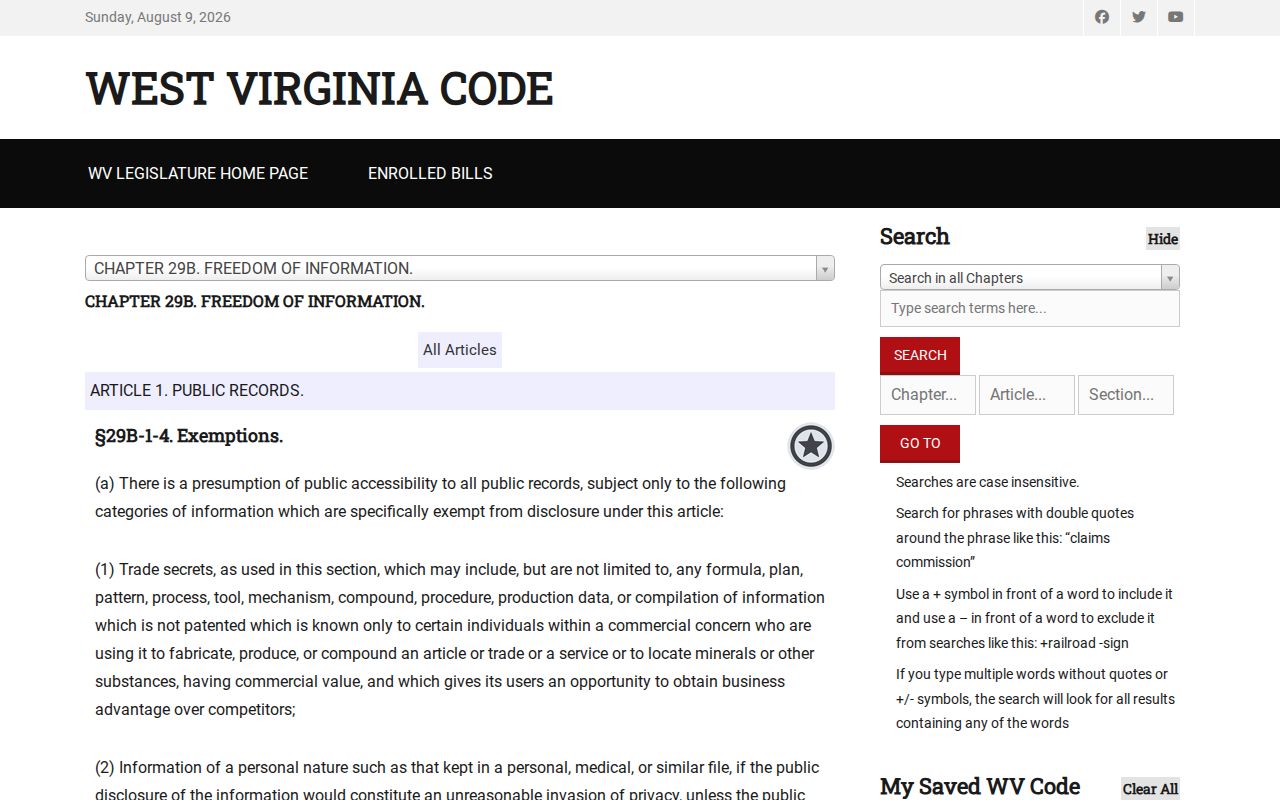
The image does not establish a release. It explains why an official response may provide part of a log while protecting other information.
If the agency reports no responsive record, ask a narrow follow-up. Confirm that the spelling, birth date, booking identifier, case number, and three-day range were searched. Ask whether another WVDCR office keeps the log, whether a transfer record exists instead, and which retention schedule controls the entry. FOIA requires access to existing releasable records, not an answer to an open-ended question. A request built around exact fields and times gives the custodian a clearer target and preserves the difference between “no matching record was found” and “the person was not released.”
Gilmer Release Roster Limits
Gilmer County release research has a structural limit: the county uses a state-run regional jail outside its borders. The public WVDCR material includes current offender search tools, daily incarceration reports, and admissions summaries, but no published 72-hour release view or archive. Admissions fields such as time, name, birth date, and gender describe entry into custody. They cannot be read backward as exits.
No official source promises how often an individual record updates, how long it remains visible after release, or how long a public history can be retrieved. “Daily” describes the report, not a retention rule. Ask WVDCR for its data dictionary, update schedule, removal practice, retention schedule, and release-log entries when the timing must be fixed. This angle is unique to the regional model because a Gilmer arrest does not lead to a sheriff-run county jail feed.
The absence of a county release feed also changes how older events should be checked. Begin with the persistent Magistrate or Circuit Court case, identify the order and case number, and then request the matching CRJCF entry. A live roster is built for present custody, while the court and facility records preserve different parts of the past event. Using both keeps a three-day estimate from becoming an unsupported historical claim.
Note: Admissions and daily-incarceration reports describe custody, not who physically exited during the three-day span.
Gilmer Release System Boundaries
No one list spans county, state, federal, court, and immigration custody. CRJCF and the WVDCR jail search cover regional-jail detainees. The prison search covers people committed to state custody, even if a Gilmer court imposed the sentence. BOP's locator covers sentenced federal prisoners, including people held at FCI Gilmer. ICE's locator serves immigration detention and cannot prove the end of criminal custody.
- Live jail result
- Evidence of listed regional-jail custody at the shown update point.
- Court order
- Legal authority for bond, dismissal, probation, sentence credit, or another custody change.
- Release log
- The agency record most likely to contain the physical exit date and time.
- VINE notice
- A status alert based on agency data, useful for notice but not a signed release order.
For an older named-person event, begin with the persistent Magistrate or Circuit case and then seek the facility entry. The full Gilmer County released inmate lookup explains how those county, state, and federal paths fit together beyond a three-day span.
FCI Gilmer is physically within the county, but it is a BOP institution and not part of this regional-jail time window. A federal result may show release or that the person is no longer in BOP custody. That record cannot be merged into a CRJCF list. Likewise, a WVDCR prison status may reflect a state transfer rather than exit to the community. Keep each result labeled by custodian, record time, and status.
Note: A system boundary is evidence, since each custodian can confirm only the records it controls.