
FCI Gilmer Federal Releases
The Federal Bureau of Prisons operates FCI Gilmer as a medium-security federal correctional institution with an adjacent minimum-security satellite camp. Its population comes from federal jurisdictions, not from Gilmer County cases as a class. A person may complete BOP custody, transfer to another federal institution, move to residential reentry or home confinement, enter another authority’s custody, or remain under federal supervised release after imprisonment.
A past release date with no current facility, or an explicit “Released” or “Not in BOP Custody” result, establishes what BOP says about its own custody. It does not prove the person is free of every restraint. The person may have a detainer, a new case, state custody, immigration custody, or court-ordered supervision. A future date is projected and can change through sentence recalculation.
| BOP label | Careful meaning |
|---|---|
| Released / Not in BOP Custody | BOP no longer holds the person |
| Past release date | Recorded departure from BOP custody on that date |
| Future release date | Projected date that may change |
| In Transit | Movement, often involving USMS, not community release |
| Unknown | The term or public date has not been determined |
Search an FCI Gilmer Release
Use the BOP Inmate Locator. A BOP Register Number is the most precise input. The locator also accepts DCDC, FBI, or INS numbers. A name search can use first, middle, and last name with age, race, and sex filters. Compare every identifier before treating the result as a match.
- Search by federal number when known; otherwise use the full name and available filters.
- Open the matching record and preserve the register number, age, status or location, and release date.
- Read a future date as projected, not as an appointment or completed event.
- Use the federal court docket for the sentencing, detention, or release order.
- Request a narrow BOP release-status record if the public result does not answer the question.
BOP says the locator covers many federal inmates from 1982 to the present and updates daily. Pre-1982 history may require National Archives research. Brief USMS or ICE custody may not appear like a sentenced BOP record. A not-found result is therefore not proof that no federal custody occurred.
FCI Gilmer Official Record
The official FCI Gilmer page supplies the institution’s identity and contact details.
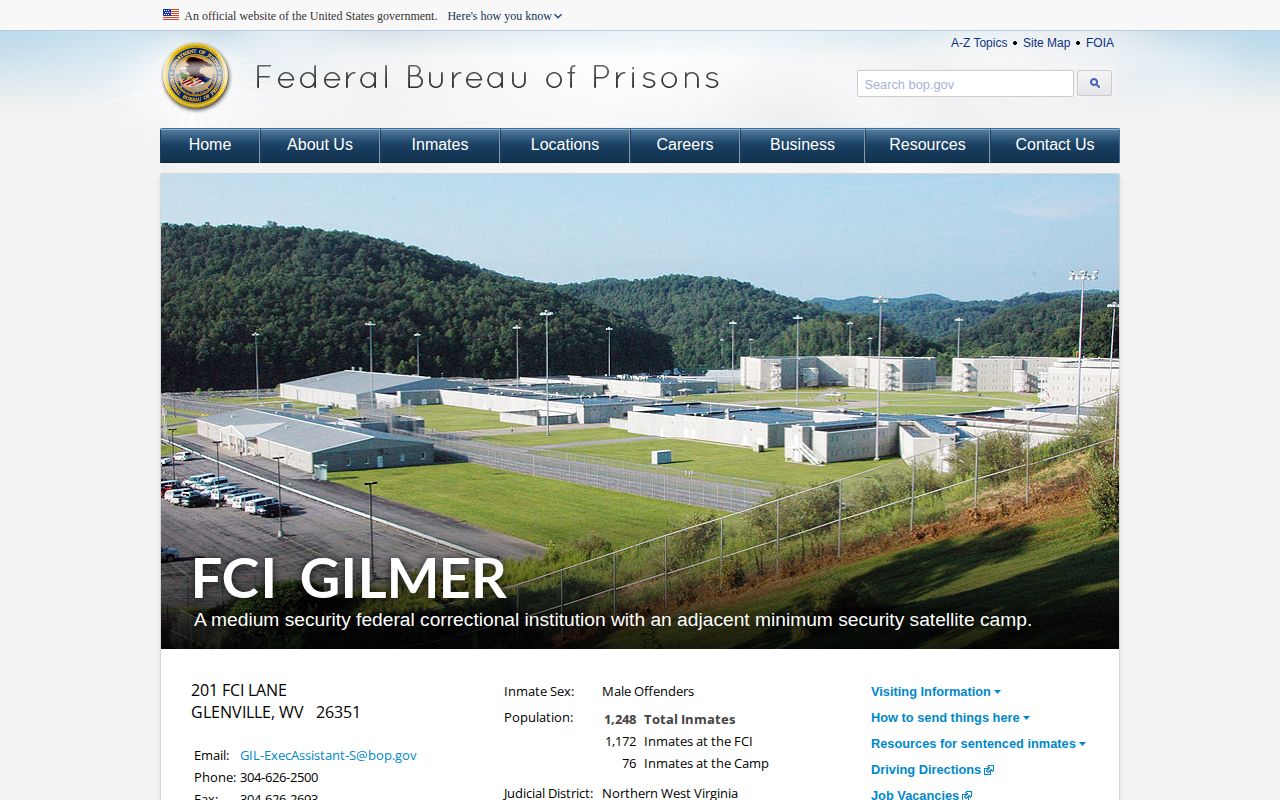
The page confirms that the complex is federal and includes the adjacent camp. It should not be used as a county release roster. Facility staff may route appropriate questions, but the public locator remains the first public release-status check.
201 FCI Lane
Glenville, WV 26351
304-626-2500
Fax: 304-626-2693
FCI Gilmer Record Requests
When the locator is not enough, use BOP’s FOIA and Privacy Act process. Ask for the smallest record that answers the question, such as public release date and status, rather than a complete institutional file. Records about another person may be restricted by federal privacy exemptions, and consent or proof of death can be required.
The BOP record-request guidance explains the federal route.
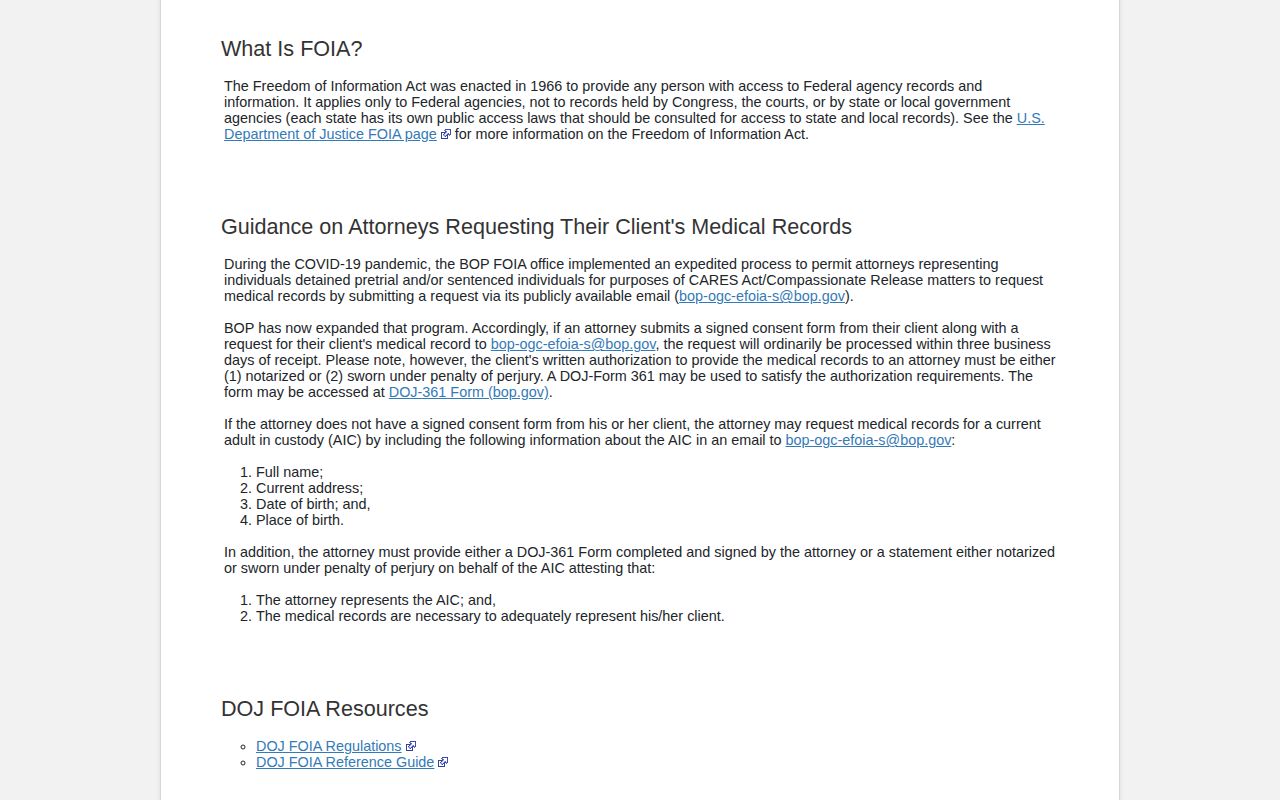
This process is separate from West Virginia FOIA. Exhaust the public locator and federal docket first, then identify the person by full name and register number, specify the release field sought, and follow the federal identity or consent requirements. USMS generally limits public prisoner information and does not offer a routine historical release locator.
A narrow federal request should distinguish a completed BOP sentence from other federal custody. Ask for the release date or custody-status record that BOP maintains, not a narrative answer about every agency that may have held the person. For confinement before 1982, BOP directs historical research toward National Archives sources because the public locator principally covers the later period. A short federal detention may also have remained under U.S. Marshals Service control without producing the same locator trail as a sentenced BOP term. In that situation, use the federal court detention or release order and an appropriate USMS inquiry. These records have separate custodians, and a negative result from one does not establish that no federal custody event occurred.
FCI Gilmer Court Proof
The federal court docket can show detention, bond, sentence, amendment, or supervised-release terms. It explains legal authority but may not mark the instant a person crossed the institution’s release point. Pair the docket with BOP’s actual release date. PACER is the normal public federal-docket channel.
Federal supervised release is court-ordered monitoring after imprisonment and is distinct from West Virginia parole. Community Corrections Management is an administrative BOP designation tied to community placement, not proof that the person is physically at the listed office. Home confinement likewise remains a form of BOP custody even though the person is not inside FCI Gilmer.
- Federal release
- Departure from BOP custody as the federal record describes it.
- Supervised release
- Court-ordered federal supervision after imprisonment.
- Residential reentry
- Community placement that may remain within BOP custody.
- Detainer
- A request or notice tied to another authority’s custody interest.
Gilmer Federal-State Naming Warning
Gilmer County has an unusual two-system geography. FCI Gilmer is a federal prison in Glenville. Central Regional Jail is a state-operated regional jail in Sutton that serves Gilmer County. Their names can send a search down the wrong path. BOP Locator covers FCI Gilmer. WVDCR jail search covers a county or regional detainee at CRJCF. WVDCR prison search covers a person committed to West Virginia state custody.
A Gilmer Magistrate or Circuit Court case does not become federal because FCI Gilmer is nearby. Conversely, a federal inmate does not belong in WVDCR merely because the institution has a Gilmer address. Ask “which sovereign and which facility?” before searching. The case number, sentencing court, register or offender number, and operator usually resolve that threshold question.
A separate timing warning applies to state parole from a regional jail. The West Virginia Parole Board advises that a person granted parole there can first move to a DCR facility for intake and fingerprinting, with an anticipated seven-to-ten-day wait before physical release. That state process does not govern FCI Gilmer. A BOP release must be read from federal records, not from the state parole timeline.
CRJCF History Shapes FCI Searches
CRJCF opened on February 22, 1993 as the prototype for West Virginia’s state regional-jail design. It serves Gilmer County from neighboring Braxton County. That history explains why ordinary Gilmer detention occurs outside the county, while the prison bearing Gilmer’s name is federal. The two facilities have different operators, case sources, records laws, and release indexes.
This history provides a practical search test. A county arrest and Gilmer court case normally lead toward CRJCF and WVDCR. A federal judgment and BOP register number lead toward FCI Gilmer. The institution name or local address alone is not enough. Confirm the sovereign, sentencing court, operator, and identifier before reading any release result.
After an FCI Gilmer Release
“Released” in BOP does not end every legal obligation. The federal judgment may impose supervised release. A detainer may send the person to state or immigration custody. A new matter can also produce another custodian. Check the docket and any receiving agency when the next status matters.
ICE ODLS is relevant only when immigration detention is plausible. USMS manages federal pretrial custody and transport but does not run prisons. The Northern District of West Virginia USMS office in Clarksburg may address an appropriate current-custody inquiry, while BOP handles sentenced federal custody. No single locator spans them all.
The Gilmer County release-search overview compares federal, state-prison, regional-jail, court, and notification routes. Use it to avoid treating a BOP result as a county release record.
Release planning must also distinguish FCI Gilmer’s main medium-security institution from its adjacent minimum-security camp. Both use BOP records, but an internal move between them is not a release. Preserve the register number and exact institution or status label. When the date is disputed, compare the locator result with the federal judgment and request the narrow BOP release-status record. That evidence identifies the sentence, BOP’s custody statement, and the recorded end of federal imprisonment without treating one administrative label as a complete account of the person’s legal status.
Note: A completed BOP term can coexist with supervised release or another authority’s custody, so confirm the next legal status.